 How-to
Does Roof Cleaning Damage Tiles? What to Know First
Last Updated: November 24, 2026
Quick Summary
Roof cleaning does not damage tiles on its own, but the wrong method, pressure and product can. Gentle cleaning with a soft wash or careful brushing is generally safe for most tile types, while high-pressure jets can strip coatings, chip edges and displace tiles. Roof cleaning damage is most likely on weathered, cracked or loose tiles.
- High-pressure jets can strip protective coatings and chip the edges of concrete and clay tiles.
- Soft washing with a biocide kills moss at the root, so it needs very little force.
- Inspect for loose, cracked or damaged tiles before any cleaning starts.
- Stop work and repair first if you find cracked tiles or failing mortar.
- Assess the result after a few weeks of normal weather, not the same day.
Table of Contents
- Does Roof Cleaning Damage Tiles?
- How Pressure Washing Affects Roof Tiles
- Soft Washing Roof Tiles and Biocide Treatment
- The Safest Way to Remove Moss from Roof Tiles
- Comparing Cleaning Methods and Their Impact on Tile Integrity
- How to Tell Professional Work From DIY Damage Risk
- How Often to Clean Roof Tiles and Checking for Damage
- Booking a Roof Clean You Can Trust
- Frequently Asked Questions
Roof cleaning does not damage tiles on its own, but the wrong method, pressure and product can. Concrete and clay tiles handle a gentle clean well, while a high-pressure jet can strip protective coatings, chip edges and push water under the tiles. Risks of pressure washing roof tiles and how to avoid them explains the specific damage a jet can cause. Knowing the difference before you book or start will protect your roof and your budget.
Does Roof Cleaning Damage Tiles?
Roof cleaning does not automatically damage tiles, but aggressive methods can. Gentle cleaning with a soft wash or careful brushing is generally safe for most tile types. Roof cleaning damage tends to come from high pressure, strong chemicals used wrongly or work done on tiles that are already cracked or loose.
How Pressure Washing Affects Roof Tiles
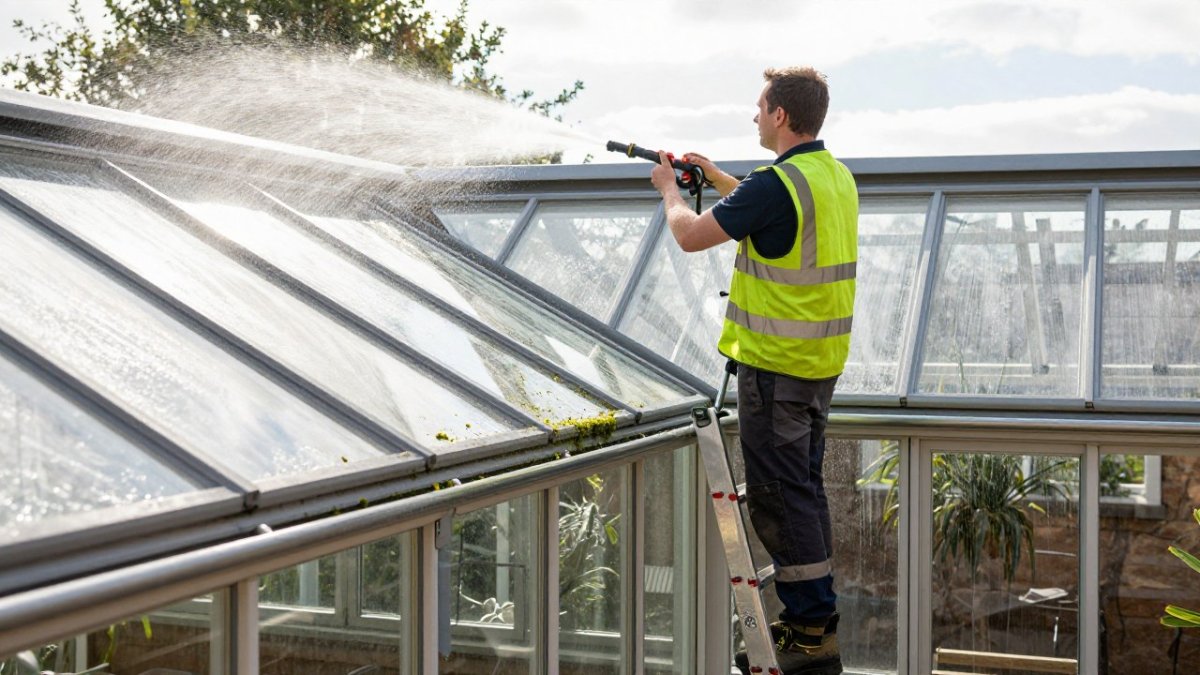
Pressure washing is the method most likely to harm roof tiles, but the risk is not uniform. How much damage a jet can do depends on the tile material, its age, its surface finish and its current condition. Treating every roof as the same is where most problems begin.
Risks of high-pressure water on concrete and clay
Concrete and clay tiles respond differently to force. Concrete tiles have a coloured top layer that wears away under a strong jet, leaving a rough, paler surface. Clay tiles are more brittle and can crack or chip at the edges when hit directly.
The main risks include:
- Chipped or cracked edges on clay and concrete tiles
- Stripped surface layers that expose the porous material beneath
- Displaced tiles that let wind and rain in
- Water forced under laps and into the roof structure
- Damage to ridge and verge tiles, which are often the weakest points
Tile-by-tile guidance: how risk changes with material, age and condition
The same jet setting that is merely wasteful on a sound concrete tile can ruin a weathered clay tile or a slate. Use this as a practical guide before anyone puts a lance near the roof.
- Weathered concrete tiles. Once the factory coating has worn thin, the surface is porous and soft. A jet can lift the top layer in a single pass, and the damage often only shows after the next heavy rain when the tile darkens unevenly. Risk: high.
- Sound, coated concrete tiles. The coating offers some protection, but a concentrated jet will still strip it in patches. Risk: moderate to high if the operator is careless.
- Clay tiles. Brittle by nature, and older clay becomes more so. Edges chip and hairline cracks open under direct pressure. Risk: high.
- Slate. Slate is strong along the grain but fragile at the edges and where it is nailed. A jet can lift or crack slates, and a slipped slate is a leak waiting to happen. Risk: high.
- Fragile or already-damaged tiles. Any tile that is cracked, loose, delaminated or previously repaired should not be pressure washed at all. The jet simply finishes what time started. Risk: very high, stop and repair first.
The older and more weathered the roof, the lower the pressure should be, to the point where pressure washing may not be appropriate at all.
Effects on protective coatings and finishes
Many concrete tiles carry a factory-applied coating that seals the surface and resists weather. A pressure washer can remove this coating in patches.
Coatings also protect against fading. Stripping them can leave the roof looking patchy and older than it is. If your tiles have a coating, ask before any work starts whether the method will keep it intact.
Watch out: a jet wash on an old, unsealed concrete tile can lift the surface layer within a single pass, and the damage often shows only after the next heavy rain.
Soft Washing Roof Tiles and Biocide Treatment
Soft washing uses a low-pressure spray and a cleaning solution, usually a biocide, to kill moss and algae at the root.
After soft washing, the dead growth washes away over the following weeks, often helped by rain. Results are not always instant, so it helps to set expectations before the job.
Biocide treatments do need care. The product must suit the tile type and be applied at the correct strength. Runoff can reach gutters, plants and drains, so the work should include steps to protect them.
The Safest Way to Remove Moss from Roof Tiles
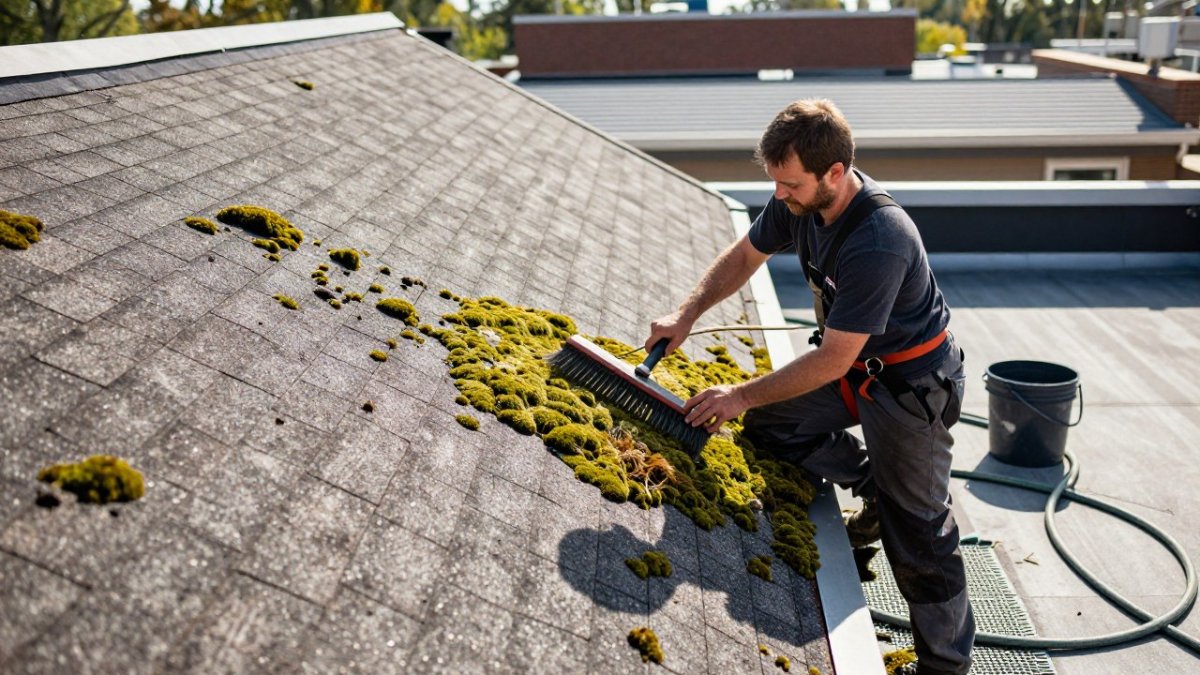
For most roofs, the safest route is to kill the moss with a biocide and let it die back, then remove the dead growth gently. Follow a step-by-step guide to safely removing moss from roof tiles for the full gentle method. Scraping or blasting the living moss off the surface often does more harm than the moss itself.
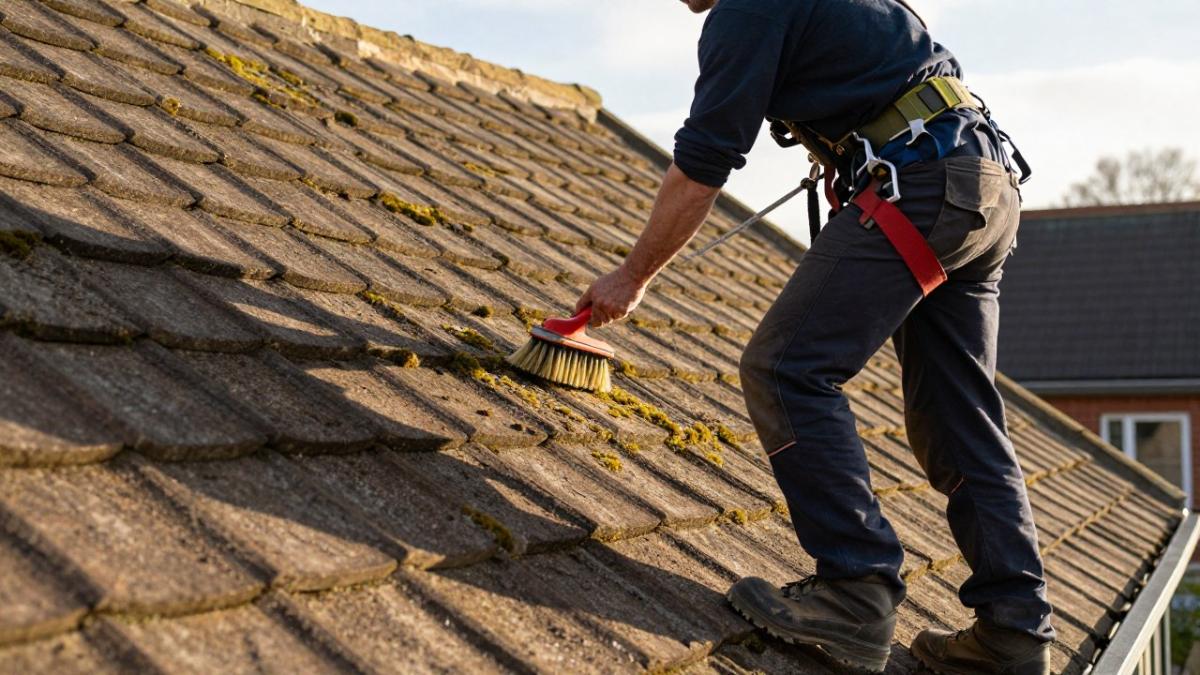
A typical safe approach looks like this:
- Check the roof for loose, cracked or damaged tiles before starting
- Apply a suitable biocide at the recommended strength
- Wait for the moss to turn brown or black, which can take several weeks
- Brush or rinse off the dead growth using low pressure
Work at height is risky. Use proper access equipment and never work on a roof alone or in wet, icy or windy weather (Roof work).
A pre-cleaning inspection and stop-work checklist
Before any treatment goes on the roof, walk the inspection from the ground and, where safe, from a ladder or tower. The point is to find the conditions that cleaning would make worse. If any of the following are present, repair first and clean later:
- Loose or slipped tiles, a jet or brush will dislodge them further
- Cracked or delaminated tiles, water will get in and freeze
- Failing mortar at ridge or verge, pressure and water will break it down
- Damaged or lifted flashing around chimneys, valleys and abutments
- Blocked or overflowing gutters, runoff has nowhere to go
- Existing damp patches or ceiling stains, there may already be a leak
- Fragile or previously repaired sections, treat these as no-go areas
Watch out: if you find any of these, stop. Cleaning over a known defect turns a small repair into a bigger one, and no responsible provider should proceed until it is fixed.
Manual scraping and when it causes harm
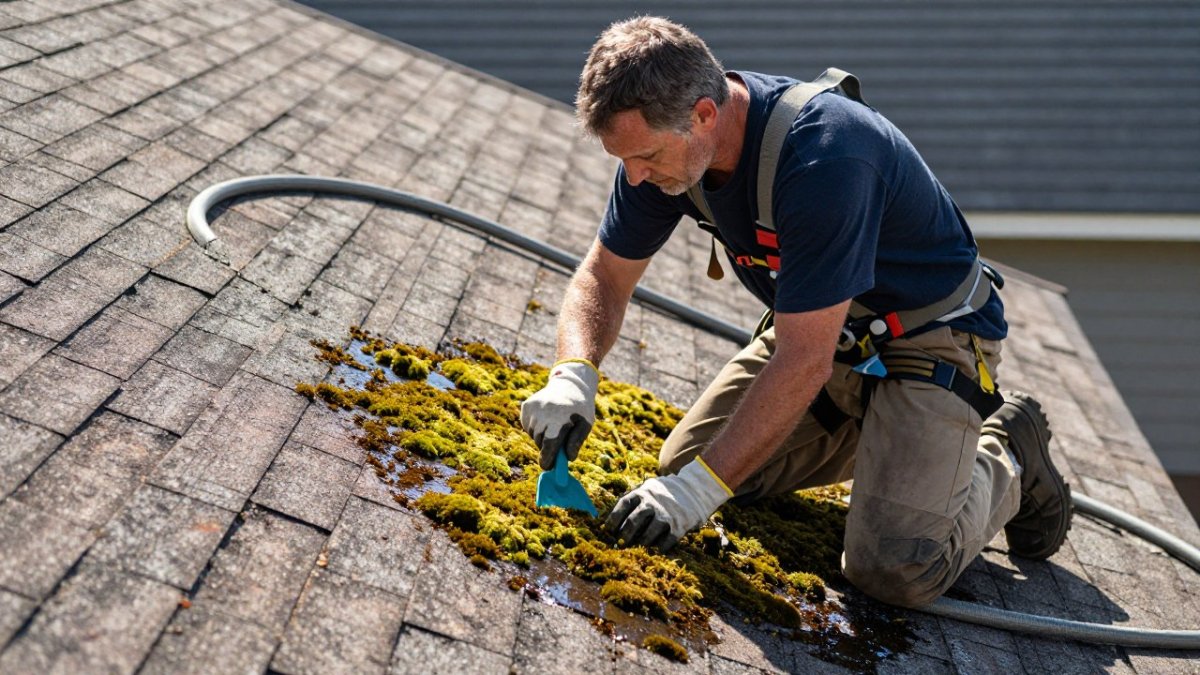
Scraping is sometimes needed, but it is easy to overdo. A metal scraper or stiff brush can gouge the tile surface and remove the protective layer. Scraping is most likely to cause harm on brittle clay tiles and on any tile with a coating.
Scraping is only reasonable when the moss is thick, the tiles are sound and a soft brush or plastic scraper is used. If you see tiles crumble or lose colour during the work, stop immediately.
What to expect after soft washing
The job is not finished when the sprayer is packed away. Dead growth weathers away over the following weeks, often helped by rain, so the roof can look patchy before it looks clean.
Assess the result after a few weeks of normal weather rather than the same day. If growth returns quickly, that usually points to a treatment applied too weak, runoff that was not managed, or a roof that stays damp and shaded.
Protecting gutters, plants, pets and drains
Biocide treatments need care beyond the tile surface. Runoff can reach gutters, borders, ponds and drains, so the work should include steps to protect them: cover or divert downpipes, keep pets and children off treated areas until dry, and avoid applying before heavy rain. Responsible handling of runoff is part of a safe clean, not an optional extra.
Comparing Cleaning Methods and Their Impact on Tile Integrity
The table below compares common cleaning methods and how each one affects tiles. Use it as a starting point, then check the result against your own roof's condition.
| Cleaning method | Effect on tile surface | Risk of cracks or displacement | Best for |
|---|---|---|---|
| High-pressure jet wash | Strips coatings, roughens surface | High | Rarely recommended on tiles |
| Steam cleaning | Moderate, depends on heat and setting | Medium | Specific tile types only |
| Soft washing with biocide | Minimal, kills growth at root | Low | Most roofs, including older ones |
| Manual scraping | Can gouge or remove layers | Medium to high | Thick growth on sound tiles |
| Gentle brushing and rinsing | Minimal | Low | Light growth and maintenance |
Pros and cons at a glance:
- Pressure washing: Fast and visible results, but the highest risk to tiles and coatings
- Soft washing: Slower and needs follow-up, but far safer for most roofs
- Manual methods: Low cost and controllable, but labour-intensive and easy to overdo
How to Tell Professional Work From DIY Damage Risk
A professional clean should start with an inspection, not a machine. Ask whether the provider checks tile condition, explains the method and tells you what could go wrong.
DIY risk rises when you use a pressure washer, buy a strong chemical without checking the tile type or work on a roof with loose or cracked tiles.
Watch out: a provider who offers to blast the roof with high pressure as the standard method is a red flag. Ask what they will do to protect the coating and the tiles.
How Often to Clean Roof Tiles and Checking for Damage
Most roofs need cleaning every few years, though shaded or damp roofs may need it sooner. Frequent aggressive cleaning wears tiles faster than occasional gentle treatment, so less is often better. Clean when moss or algae is clearly building up, not on a fixed schedule alone. Seven steps to stop moss returning on your roof can also reduce how often cleaning is needed.
Between cleans, check the roof from the ground with binoculars and look for:
- Tiles that are cracked, chipped or slipped out of line
- Patches where the colour or surface has worn away
- Water stains on ceilings or walls below the roof
- Gutters that overflow or stay blocked
If you notice any of these, get the roof inspected before cleaning. Cleaning over an existing leak or loose tile can make the problem worse.
Booking a Roof Clean You Can Trust
When you book a roof clean, look for a provider that is fully insured, trained and experienced with safe access. Compare roof moss removal services in the UK, with costs and methods to see local options and what they cost.
At The roof cleaner, our team is fully experienced, trained and insured, and we are equipped to safely access difficult-to-reach roof areas.
If you are unsure whether your tiles can take a clean, a short inspection will tell you what is safe to do.
Frequently Asked Questions
Can pressure washing damage roof tiles?
Yes. High-pressure jet washers can strip protective coatings, erode the surface of concrete tiles and dislodge or crack clay and slate. Damage is more likely on older, weathered or already loose tiles. Low-pressure or soft washing with a suitable biocide is generally the lower-risk option, and a good cleaner will inspect the roof first and stop if tiles look fragile. Always ask what pressure will be used before work starts.
Is soft washing safe for roof tiles?
Soft washing is generally considered safer than pressure washing because it relies on a low-pressure application of a biocide solution that kills moss, algae and lichen over time rather than blasting them off. It still requires care: the solution must be correctly diluted, rinsed off gutters and plants, and not applied to tiles that are cracked or crumbling. Expect the dead growth to weather away over several weeks rather than vanish instantly.
How often should roof tiles be cleaned?
Many UK roofs in shaded or damp areas benefit from cleaning every two to three years, while sunnier, more open roofs may need attention less often. Moss regrowth and the condition of the tiles should guide the timing. Over-cleaning can wear finishes, so a professional inspection to decide whether cleaning is needed is a sensible starting point before booking work.
When should roof tiles be replaced rather than cleaned?
Replacement is worth considering when tiles are cracked, crumbling, delaminating, loose, or letting water into the roof space. Cleaning will not fix these faults and an aggressive clean can make them worse. If you notice leaks, damp patches or missing tiles, have a roofer assess the roof before any cleaning is carried out.